“Cut your losses fast” sounds like discipline. Applied mechanically, it can turn ordinary market noise into a string of realized losses—and leave you watching the original move continue without you.
The problem isn’t taking a loss. It’s treating every drawdown as proof that your trade is wrong. A trader should exit when the reason for the trade has failed, not simply because the price moved against them for a while.
What everyone believes
The conventional case is simple: small losses are manageable; large losses can wreck an account. Set a stop, honor it, and never let hope turn a bad trade into a disaster. That advice exists for good reason. A trader who refuses to accept a genuine invalidation can turn a planned risk into a catastrophic one.
But a sound warning has hardened into a crude rule: the faster you exit a losing position, the better. That is not risk management. It is a reflex—and markets are very good at punishing reflexes.
Why that’s wrong
A position can be down without the trade thesis being broken. Price does not move in a straight line toward a target. It retraces, tests levels, reacts to short-term order flow, and sometimes moves sharply against a sound idea before resuming. If your only exit criterion is “I’m in the red,” you are using the existence of a drawdown as a substitute for analysis.
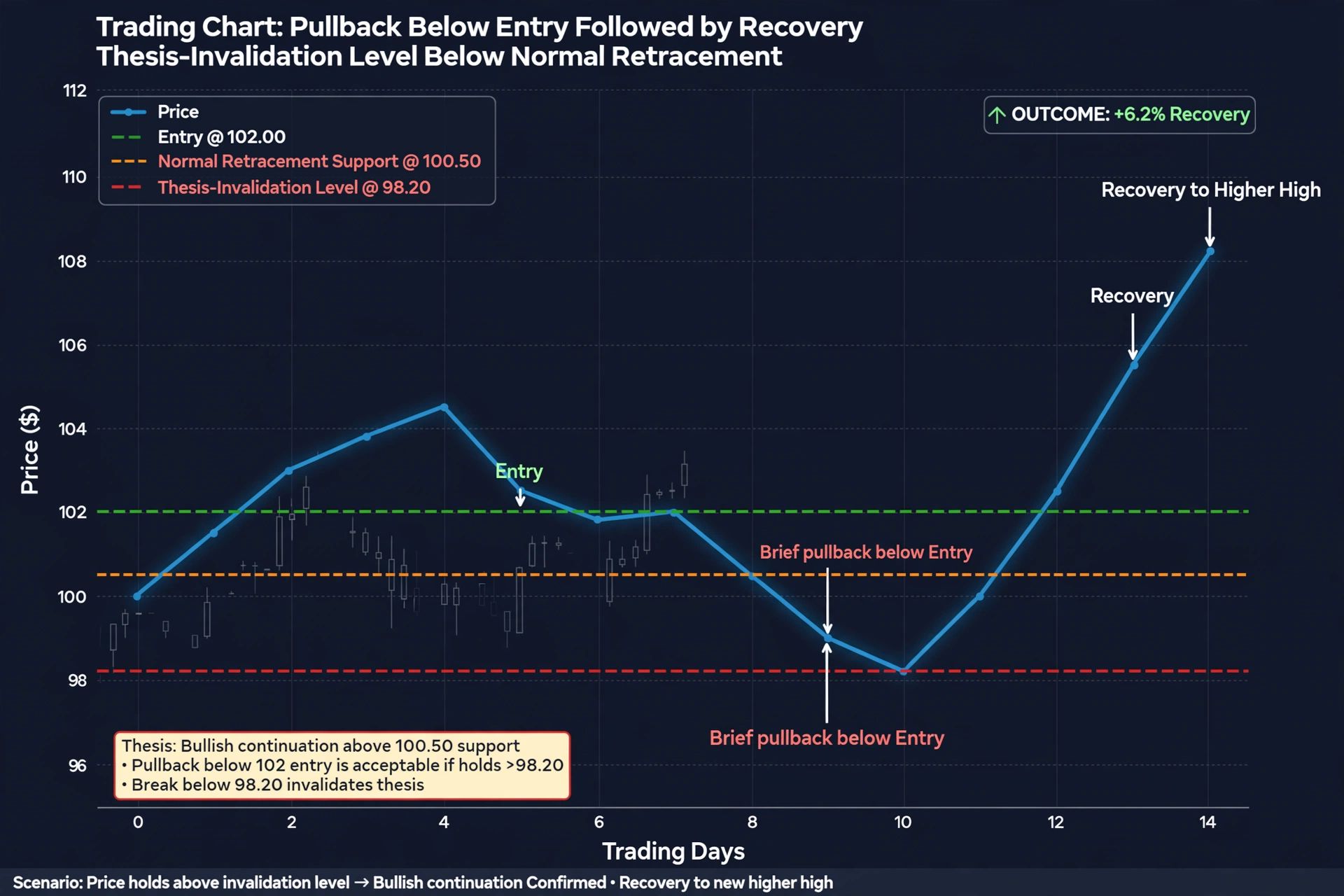
Consider a hypothetical trader who buys at $100 because a breakout has cleared a meaningful resistance area. They plan to exit if price falls back below $95, where the breakout would be invalidated. Price dips to $97, then recovers and reaches $110. If the trader instead uses a tight, arbitrary $2 stop, they leave at $98: a $2 loss on a trade whose stated thesis remains intact. If they re-enter at $103 after the recovery becomes obvious, they have paid for the same idea twice—first with a loss, then with a worse entry.
That is not an argument for giving a losing trade unlimited room. It is an argument for deciding what would actually prove the trade wrong before entering it. A stop at a price unrelated to the setup can be hit by routine volatility. A stop tied to the setup’s invalidation has a reason to exist.
The familiar maxim also confuses two different questions: “How much can I afford to lose?” and “At what price is my thesis no longer credible?” The first is a position-sizing problem. The second is a market-structure problem. Solving the first by placing a stop wherever a small loss feels comfortable may create an exit that has nothing to do with the second.
If the setup needs a wider stop to survive normal movement, the answer may be to trade smaller—not to squeeze the stop closer and pretend the underlying risk has disappeared. A smaller position can keep the planned account risk within bounds while allowing the trade enough room to behave normally. If the necessary stop makes the trade unattractive, skip it. That is discipline, too.
The strongest case for “cut losses fast” is that traders are exceptionally good at rationalizing. They move stops, invent new explanations, and wait for a losing position to come back. A hard stop can interrupt that behavior, cap exposure, and keep one mistake from becoming a portfolio-level problem. That is a real benefit.
But it does not prove that every tight stop is wise. It proves that risk must be defined and enforced. A stop based on genuine invalidation, volatility, or a preplanned maximum loss can do that. A stop triggered by the mere discomfort of being temporarily wrong can simply automate bad judgment.
What I’ve seen instead
The repeatable failure pattern is not mysterious. A trader identifies a setup, enters with a thesis, then abandons the thesis at the first uncomfortable candle—without any new information that actually contradicts it. Price later recovers. The trader, now afraid of missing the move, buys back at a less favorable level. One idea has produced an initial loss, a worse entry, and often a second exit made under pressure.
You can recognize this pattern without pretending every stopped-out trade would have recovered. Some would not. That is exactly why the review needs to distinguish between a valid stop-out and a stop that was simply too close for the setup. Look at a meaningful sample of trades, not the one chart that makes the best story. Record the entry thesis, planned invalidation, stop distance, position size, and what price did after the exit. Then ask whether the stop was hit because the thesis failed or because ordinary movement reached an arbitrary line.
That review may reveal that a strategy has a high rate of small losses—and that those losses are not automatically evidence of excellent discipline. If the same setup repeatedly exits on routine pullbacks before moving in the intended direction, the exit rule may be degrading the strategy. The answer is not to cling harder to every loser. It is to test whether the stop, entry, or setup is poorly designed.
There is no honest universal percentage for how many stopped trades will rebound. It depends on the instrument, timeframe, strategy, volatility, and how the setup is defined. Anyone offering a guaranteed fix without those details is selling certainty the market does not provide.
What this means for you
Before entering, write down three things: why the trade should work, what observable event would invalidate that reason, and how much you will risk if it does. Size the position so the planned loss is tolerable. Place the stop where the thesis fails—not wherever the loss looks smallest on the screen.
Then keep the stop. “Give the trade room” is not permission to move the invalidation point farther away after price approaches it. If new evidence breaks the thesis, exit. If the trade was sized too large, reduce the size rather than rewriting your plan in the heat of the moment.
Finally, review exits as a system. Track whether stops are being hit by ordinary volatility, whether the original setup is genuinely failing, and whether re-entries are repeatedly happening at worse prices. Compare the actual results of alternative, pre-defined exit rules across enough trades to make the comparison meaningful. A handful of dramatic examples is not evidence; a consistent log is more useful.
The bottom line
“Cut losses fast” is not a complete trading rule. Used literally, it can make you exit normal retracements, lock in avoidable losses, and chase the same move at a worse price. Define what invalidates the trade, size for the risk, and exit when the thesis—not merely your comfort—has failed.