“Never add to a loser” is a useful warning against reckless trading. It is not a law of markets. If you have already defined your maximum risk, planned your entries, and still have a valid reason to hold the trade, adding at a better price can be more disciplined than repeatedly bailing out and chasing the same position higher.
What everyone believes
The standard advice is simple: if a trade is losing, don’t put more money into it. Adding to a losing CFD position looks like refusing to admit you were wrong. Worse, it can resemble the gambler’s fallacy: believing a losing trade is “due” to turn around because it has already fallen.
That warning is right when traders add impulsively, increase their risk limit, or use a lower price as their only reason to stay in. But the slogan turns a real danger into an absolute rule. It treats every planned second entry as if it were an emotional rescue mission.
Why that’s wrong
The relevant question is not, “Am I adding to a loser?” It is, “What is my total risk if I take the next planned entry, and is the reason for the trade still intact?” Those are different questions. The first focuses on the trade’s current profit and loss. The second focuses on the decision still available to you.
Consider a simplified example. A trader buys one CFD unit at 100 and plans a firm exit at 90. The position’s planned loss at that level is 10 price units, before financing, spread, slippage, and any other costs. The trader has also planned to add one unit at 95 if the original setup remains valid. If both units are closed at 90, the price loss is 10 on the first unit and 5 on the second: 15 in total.
That is not an unlimited bet. It is a staged entry with a known, larger total loss—one the trader must budget for before placing the first order. The average entry becomes 97.5, rather than 100. If the price recovers, the second unit benefits from that lower entry. If it keeps falling, the trader takes the pre-planned loss. The arithmetic does not make the trade good; it makes the risk visible.
Now compare that with repeatedly exiting on a dip and re-entering after the price bounces. Each exit and new entry can incur another spread, and a fast move can mean slippage or a worse re-entry price. A trader can end up paying repeatedly to abandon a thesis temporarily, then buy back in at a less favorable level. A planned add is not automatically cheaper, either—but the blanket rule ignores the costs and execution risks of the alternative.
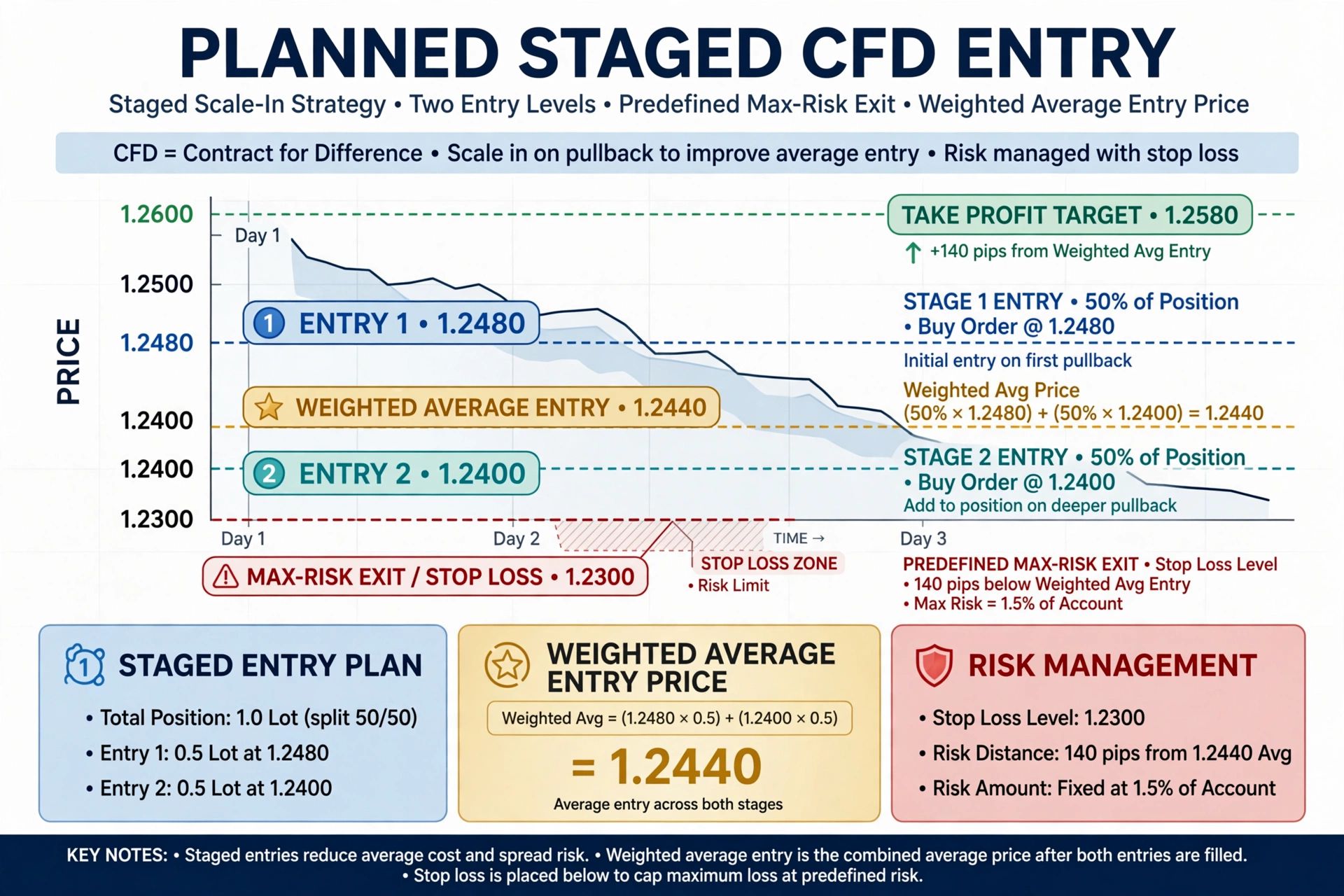
The strongest argument against averaging down is that losses can tempt traders to move the goalposts. They add once, then again. They widen the stop. They call every new decline “noise.” That is not a reason to ban planned adds; it is a reason to make the risk budget binding. If the total position breaches the limit you set before the trade, the plan has failed. If the thesis is invalidated, the position is wrong—even if the average entry would look better with one more add.
A lower average entry is not proof that a trade is safer. More units mean more exposure, and CFDs can magnify losses through leverage. Stops may execute at worse prices in fast markets, and overnight financing or other charges can matter if a position is held. Any honest comparison has to include those costs and risks, not just the attractive average price on a screen.
But this cuts both ways. “Never add to a loser” is often presented as if cutting and re-entering were costless and emotionally neutral. It isn’t. If a trader’s planned entries are at 100 and 95, exiting at 96 only to chase a bounce at 99 can mean paying for another round of execution and ending up with a worse entry than the plan allowed. The moral label “averaging down” doesn’t make that alternative more rational.
What I’ve seen instead
I don’t have brand trading records or audited results to claim that staged entries outperform a particular exit-and-re-entry strategy. So I won’t invent a win rate or pretend one example settles the debate. The case is about process and arithmetic: a planned add has a calculable contribution to total risk; repeated exits and re-entries have costs that deserve to be counted too.
In the example above, the trader knows the price-loss exposure at the planned exit is 15 units across both entries. That number is available before the add. The trader can reject the trade if 15—plus a reasonable allowance for costs and execution uncertainty—is too much. By contrast, a trader who treats every dip as a reason to exit and every rebound as a reason to chase can accumulate several separate decisions, each with its own costs and risk of poor execution, without ever comparing them against one coherent plan.
That doesn’t establish that adding is always better. It establishes why the command to never add is too crude to guide a serious decision. The disciplined comparison is between two complete plans, with their entry prices, exit conditions, total exposure, and costs—not between a supposedly virtuous small loss and a supposedly shameful add.
What this means for you
Before opening a CFD position, write down the maximum amount you are prepared to lose across every planned entry. Include a buffer for spread, financing, and possible slippage; a stop price is not a guarantee of an exact fill. If you cannot define the total exposure in advance, don’t add.
Set the conditions for any additional entry before the price moves. A price level alone is not a thesis. Specify what evidence would keep the setup valid and what would invalidate it. If the invalidation point arrives, close the trade. Do not widen the exit or invent a new reason to hold simply because your loss is larger than expected.
Then compare the staged plan with the alternative you would actually use. Would you cut and re-enter? At what price? How many times? What execution costs and slippage could that involve? Be realistic rather than assuming your preferred alternative happens at perfect prices.
Finally, size the entire trade—not just the first entry—to a loss you can afford. With leveraged products, that means understanding how a move in the underlying translates into a loss on your CFD position, and allowing for the possibility that execution is worse than planned. If the answer is uncomfortable, reduce the size or skip the trade. Averaging down is not a license to keep adding; it is a choice about how to deploy a risk budget you already set.
The bottom line
Averaging down is not inherently reckless. Unplanned escalation is. When the thesis remains valid, the total risk is fixed in advance, and the alternative is repeated cutting and chasing, a staged add can be the more rational execution plan.
Stop treating “never add to a loser” as a substitute for risk management. Count the full position, count the costs, and follow the plan you made before the trade turned against you.