If you’re new to CFD trading, don’t assume a course is the responsible first purchase. For most beginners, paying for someone else’s lessons is a worse use of money than placing tiny, tightly limited live trades and learning how you react when your own money is at risk.
That does not mean you should rush into large positions or treat losses as tuition you can afford to ignore. It means the part of trading you most need to learn is personal: what you do when a trade moves against you, when a winner starts to fade, and when your plan collides with the urge to act. A course can describe those moments. It cannot make your decisions in them.
What everyone believes
The case for a paid course sounds sensible. Beginners make avoidable mistakes; instructors have already made them; therefore, a structured course can help a new trader skip the painful part. It may offer lessons on order types, technical analysis, risk management, and trading plans in one convenient package.
That argument is strongest when the course is affordable, transparent about risk, and focused on sound basics rather than promises of quick profit. A good explanation can save time. And nobody needs to lose money just to discover that leverage magnifies losses or that a stop-loss order matters.
But knowing a rule and following it under pressure are different skills. The sales pitch tends to blur them.
Why that’s wrong
A course can explain that traders should keep losses small. It cannot tell you whether you will actually close a losing position—or widen your stop because you don’t want to admit you were wrong. It can show a backtested strategy with tidy entries and exits. It cannot recreate the feeling of watching your own account fluctuate while deciding whether to stick to the plan.
That distinction is the whole issue. A beginner’s costly mistake is not always ignorance of a rule. Often, it is knowing the rule and abandoning it in the moment. Someone else’s slides can provide language for that problem, but only your own decisions reveal how it shows up in you.

Consider two beginners who both understand the same lesson: don’t risk more than a small, predefined amount on one trade. In a lesson, both can repeat it. In a live position that turns red, one may accept the planned loss. The other may add to the position, move the exit farther away, or close it too early and then chase the market. The course didn’t fail to explain the rule. The problem is that explanation alone did not reveal what each person would do under pressure.
A small live position can reveal that behavior directly. The point is not to make money from it. It is to observe whether your written plan survives contact with a real decision. If the emotional response is too strong even at a tiny size, that is useful information: reduce the size, pause, or return to simulation until you can follow a process. A live trade is feedback, not a badge of seriousness.
There is also a basic question of what your money buys. A course buys access to material, structure, and perhaps feedback. Those can be useful—but only if the instruction is trustworthy and you use it. Money reserved for learning through minimal live exposure buys something a prerecorded example cannot: a direct record of your own choices. A trading journal can then show whether you followed the plan, what triggered a deviation, and what to change before risking more.
That feedback is not automatically valuable. If you trade randomly, risk too much, or treat every loss as a reason to place another trade, you can learn the wrong lessons quickly. Small size, a defined plan, and a journal are not optional decorations; they are what turn an experience into evidence rather than an expensive impulse.
The counterargument is that a course can prevent beginner losses before they happen. Fair point: a beginner should learn how CFDs, leverage, margin, costs, and order execution work before risking money. But you do not need an expensive mentor to begin with those fundamentals. Reliable educational materials and a demo account can help with mechanics; a course is worth considering only if it offers demonstrable value beyond that, without implying that it can remove risk or guarantee results.
The mistake is treating “I paid to learn” as proof that you are now prepared. Payment is not competence. Finishing a course does not certify that you can control risk when the position is yours. And a confident instructor’s example is not evidence that the same approach suits your finances, temperament, or circumstances.
What I’ve seen instead
I’m not going to pretend I have a private stack of student results or a verified dataset proving that live practice beats every course. The useful evidence here is more basic and more personal: trading decisions happen in real time, and a beginner cannot know their own response to a real loss by watching somebody else describe theirs.
Imagine a new trader who spends several hundred dollars on a polished course, memorizes a setup, then opens a position and immediately feels compelled to check it every few minutes. If the trade loses, they hesitate to exit; if it wins, they take profit too early. The course may have explained patience and risk limits perfectly. What the beginner has discovered is that the practical obstacle is not another chart pattern—it is behavior under uncertainty.
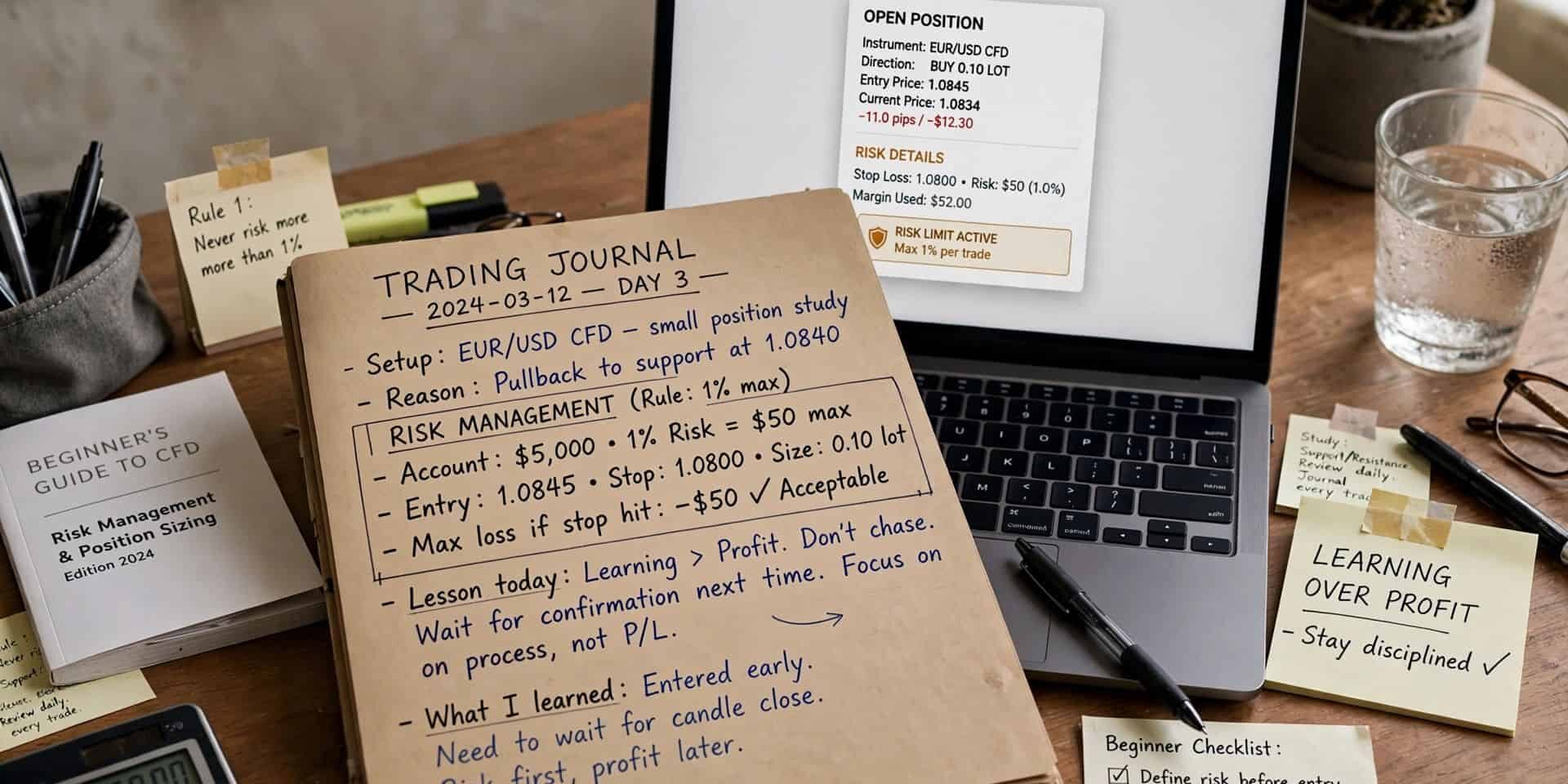
Now imagine that same person instead starts with a small, pre-set amount they can genuinely afford to lose, writes down the entry, exit, and maximum loss before trading, and records whether they followed each rule. A loss still costs money, which is why the size must stay small. But the journal gives them specific questions to investigate: Did I change the exit? Did I trade because of a signal or because I was bored? Did I take a second position to recover the first loss?
Those answers are more relevant than a generic promise that a strategy worked in someone else’s example. They do not establish that the trader has an edge, and they are not a reason to scale up. They identify what needs work before any increase in risk is even considered.
What this means for you
First, learn the mechanics and the risks before trading. Understand how leverage, margin, spreads, overnight charges, and forced closure can affect a CFD position. If you cannot explain how a loss could exceed what you expect, do not open the trade.
Second, set a strict learning budget. Use only money you can afford to lose, keep any position genuinely small, and decide the maximum loss before entry. Never borrow to trade or increase size to make a lesson feel more consequential. If a loss would threaten bills, savings, or peace of mind, the position is too large—or live trading is not appropriate for you now.
Third, keep a journal that records the plan and what you actually did. Review behavior, not just profit and loss. A profitable trade that broke your rules is not proof the rules are unnecessary; a losing trade that followed them is not automatically a bad decision. One outcome cannot validate a strategy.
Finally, consider paying for instruction only when you can name what it provides that you cannot get elsewhere. Check the instructor’s claims, the full cost, refund terms, and whether the teaching emphasizes risk rather than income promises. A course may be a sensible purchase for structure or specific technical knowledge. It is not a shortcut around the need to make and review your own decisions.
The bottom line
For most beginners, a paid course is a worse first use of money than carefully limited live practice, because no instructor can supply the personal feedback that comes from handling your own risk. Learn the mechanics first, keep the stakes tiny, and treat every trade as an observation—not proof that you should trade bigger.