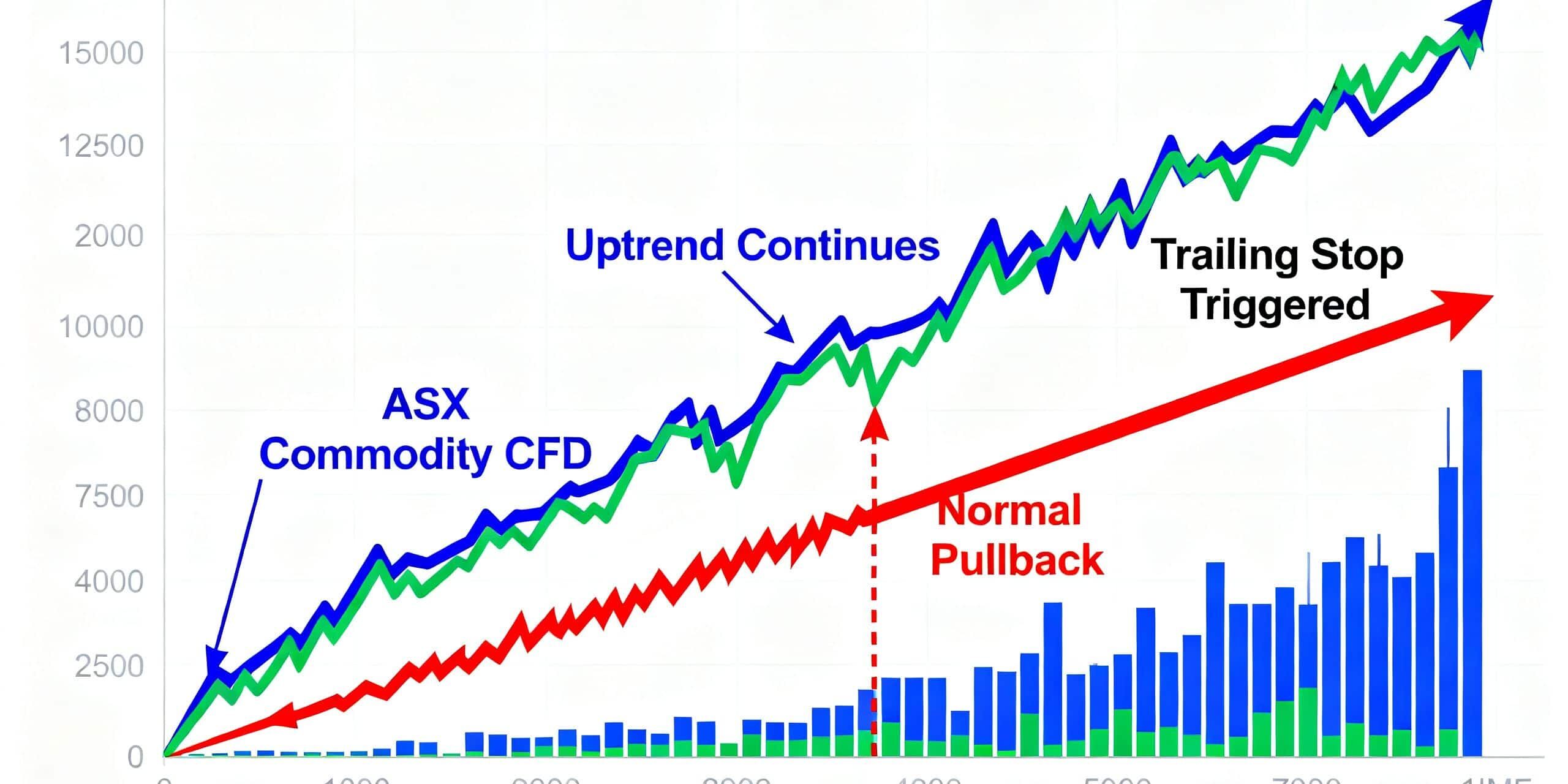
Trailing stops are widely sold as the disciplined way to “let winners run” while locking in profit. I think that advice is often backwards. On a strong ASX or commodity trend, a trailing stop set too tightly does not protect the trade—it ejects you from it at the first normal pullback.
What everyone believes
The consensus sounds sensible: once a CFD moves in your favour, move your stop behind it. That way, you supposedly preserve gains without having to predict the exact top.
A fixed percentage, a set dollar distance or an ATR multiple creates a simple rule. Price rises, the stop follows. Price reverses far enough, the position closes. No second-guessing. No watching an open profit turn into a loss.
There is a genuine strength in that approach. Traders do need an exit plan. Hope is not a risk-management system, and refusing to take a loss—or a profit—because the chart “might come back” is a reliable way to make bad decisions worse.
But the neatness of the rule is exactly what makes it dangerous. The stop does not know whether a move is a healthy retracement or a genuine reversal. It only knows that price crossed a line.
Why that’s wrong
The advice to “trail your stop so you never give back profit” treats all pullbacks as evidence that the trade is failing. Trending markets do not behave that way.
A strong trend rarely moves in a straight line. It advances, pauses, retraces, tests a prior breakout level and then continues—or fails. The pullback is not an exception to the trend. It is part of the trend’s structure.
That creates the central problem: a fixed trailing distance is usually calibrated to protect a position, not to understand the market’s current rhythm. A percentage-based stop may be absurdly tight for a volatile mining CFD. A small ATR multiple may be reasonable during a quiet session but useless when commodity prices are moving sharply. The same rule can be too loose in one regime and too tight in another.
Consider an ASX resources CFD breaking above a well-established range. The initial move attracts buyers, then the price retreats to test the breakout. That retreat may look ugly in real time, particularly after the position has built a paper profit. But if the market holds the breakout area and resumes higher, the pullback was information—not an exit signal.
A trailing stop placed just beneath the latest price can close the trade during that test. The trader then watches the original position continue higher from the sidelines. Worse, the exit can create the illusion that the strategy worked: the trader banked a profit. The missed continuation is harder to record, but it is often the more important cost.
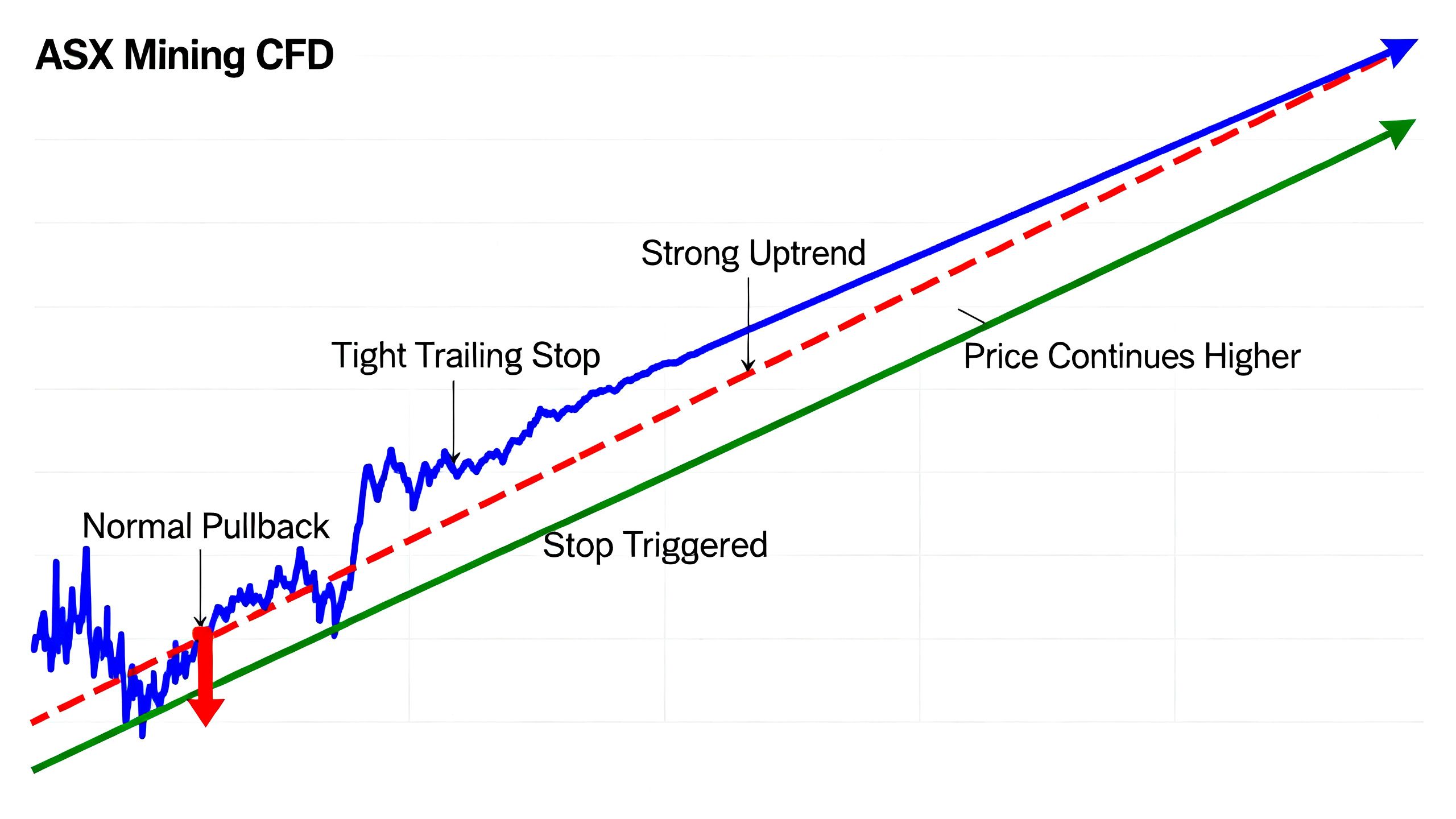
The same issue appears in commodity CFDs. Markets such as oil, gold or iron ore can make sizeable intraday swings without changing their broader direction. A stop that sits at a tidy fixed percentage may be inside the market’s ordinary noise. It is not protecting the trade from a structural reversal; it is simply competing with volatility.
The strongest objection is worth taking seriously: without a trailing stop, a profitable trade can reverse and give back a large portion of its gains. That is true. Traders who turn every winner into a hope-filled hold are not demonstrating patience; they are abandoning their plan.
But the answer is not to pretend every retracement is a reversal. The answer is to define what would actually invalidate the trade. A break below a meaningful swing low, a failed retest, a change in market structure or a close beyond a key level may matter far more than an arbitrary percentage from the high.
A mechanical exit is not automatically a rational exit.
What I’ve seen instead
The most revealing comparison is not between “stop” and “no stop.” It is between a stop that follows price mechanically and one that responds to the reason the trade was opened.
Suppose the original idea is a trend continuation after a breakout. The trade has a logical failure point: price should not convincingly fall back into the old range. If price pulls back but holds the breakout zone, the thesis may still be intact. If it closes back inside the range and cannot reclaim it, the thesis has weakened materially.
A tight trailing stop ignores that distinction. It can take the position out while the thesis remains valid. A structure-based exit at least asks the right question: has the reason for the trade disappeared?
This is particularly important with Australian CFDs because the instruments traders watch can be volatile and unevenly liquid. A sharp wick can travel through a nearby stop before price recovers. The chart may print a temporary low, trigger the exit and then finish the session in the direction the trader originally expected.
That does not mean every stop hunt is evidence of market manipulation. Often it is simply the normal consequence of placing an exit where many other traders place theirs: just under a recent low, just beyond a round number or at a universally advertised ATR distance. Crowded, obvious levels are not automatically wrong, but they deserve scrutiny.
The practical evidence is in the trade journal. Record the initial stop, the trailing rule, the price at exit and what happened afterward. Then separate two outcomes:
- Did the market invalidate the original setup after the exit?
- Or did the stop trigger during a normal pullback before the trend resumed?
Those are not the same result. A profitable exit can still be a poor decision if the rule repeatedly removes you before the main move. The relevant measure is not whether a stop captured a few points. It is whether the exit method preserves exposure to the moves your strategy is designed to capture.
What this means for you
First, stop treating “locking in profit” as an unquestionable good. Profit is not protected merely because a line is moving upward behind price. A stop can lock in a small gain while destroying the trade’s expected upside.
Second, set the initial stop where the trade is genuinely wrong, not where the potential loss feels emotionally comfortable. If that distance is too large for your account, reduce the position size. Do not force a sensible market stop into an unsuitable position size by tightening it until ordinary volatility takes you out.
Third, distinguish between managing risk and managing discomfort. Moving a stop close to price often feels responsible because the open profit becomes safer. But the decision may be driven by anxiety rather than market structure.
Fourth, consider waiting for evidence before tightening. Price can earn a tighter stop by forming a new higher low, breaking and holding a fresh level, or showing that volatility has contracted. A stop that moves because the position is profitable is not necessarily better than one that moves because the market has provided new information.
Finally, test the rule on the actual CFD and timeframe you trade. A trailing method that looks sensible on a broad equity index may be hopeless on a fast-moving commodity. Review enough trades to see whether the rule captures trends or merely harvests small wins before larger continuations.
You do not have to abandon trailing stops entirely. You do have to stop worshipping them. Use them when they fit the market’s structure and volatility—not because trading folklore says every winner must be followed by a leash.
The bottom line
Trailing stops do not automatically let winners run. On trending ASX and commodity CFDs, tight mechanical trails often cut winners short during the normal pullbacks that make sustained trends possible. The better question is not “How quickly can I protect this profit?” but “What market evidence would prove this trade is wrong?”
Manage the risk, size the position properly and give the trade enough room to behave like the market you chose to trade. A stop should protect your thesis from failure—not protect you from every uncomfortable fluctuation.