New data from the Australian Securities and Investments Commission (ASIC) has revealed that a significant majority of retail traders in the Contracts for Difference (CFD) market are consistently losing money, highlighting the volatile nature of high-risk derivative products. As the primary regulatory body overseeing these financial services, ASIC’s sector-wide review provides an unfiltered look at the actual trading outcomes for hundreds of thousands of individual investors.
What we found
Our analysis of the ASIC FY 2024 data reveals clear patterns in how retail clients fare in the CFD market:
-
The Loss Rate: 68% of all retail CFD clients realized a net financial loss during the fiscal year.
-
The Total Impact: Collectively, retail clients incurred net losses amounting to $458 million, a figure that includes $73 million in trading fees.
-
The Options Barrier: Retail clients who trade options-based CFDs face significantly higher risk, with 85% of these traders finishing the year in the red.
-
Fee Friction: Even among the 32% of retail clients who were profitable, trading fees prevented an additional 5% of all retail traders from achieving a net profit.
-
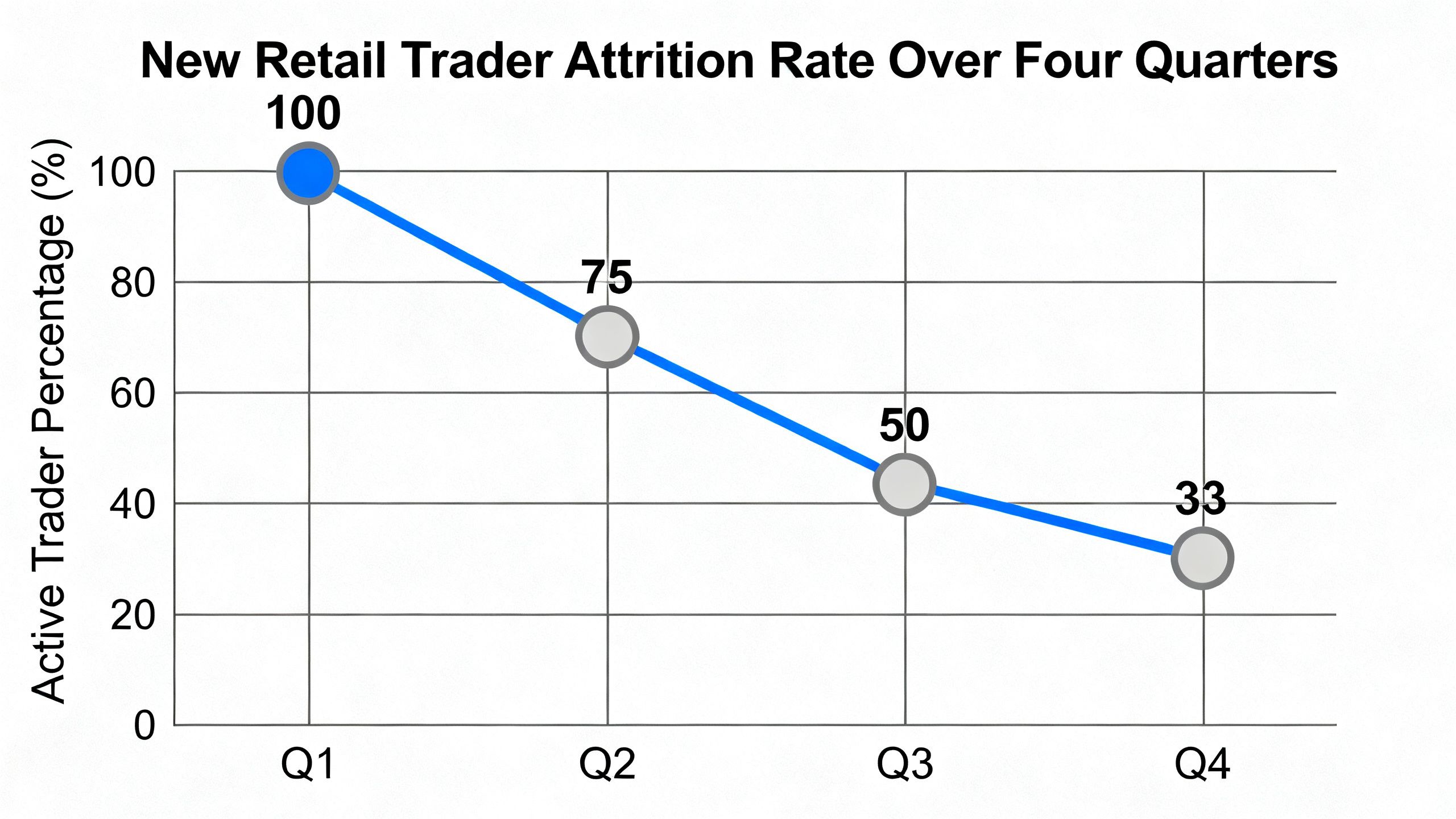
The Churn Factor: The sector experiences extremely high attrition; 67% of new retail clients who placed their first trade in the first quarter of FY 2024 had stopped trading by the end of the year.
Why this matters
For the retail investor, this data acts as a necessary dose of reality. The CFD market is often marketed as a tool for diversification or active participation in financial markets, but the sheer volume of net losses suggests that for the average user, the barriers to success are substantial. When nearly 7 out of 10 participants are losing money, it is clear that CFD trading requires a level of oversight, discipline, and understanding of leverage that is not commonly held by the typical retail cohort.
The impact of these losses is not just in the market movement; it is heavily exacerbated by fees. For many investors, trading frequency is a trap. The data confirms that as clients move from 0–5 monthly positions to upwards of 50, the percentage of loss-making clients increases significantly. This suggests that the cost of execution—the “friction” of the trade—often consumes the potential upside that an investor might hope to capture.
The detail behind the numbers
When we segment the data by acquisition channel and trading behavior, the narrative shifts from “bad luck” to “poor outcomes linked to product design.” For example, new retail clients acquired via paid online advertising showed a higher tendency for losses (74.13%) compared to those acquired through other means.
Furthermore, the complexity of the product correlates directly with the likelihood of failure. Fixed-income and index-based CFDs saw lower loss percentages (around 52% and 60% respectively) compared to the 85% loss rate for options CFDs. This confirms that investors using more complex, multi-layered derivative products are essentially running uphill against a system that, through leverage and fee structures, makes consistent profitability exceptionally difficult.
How this compares to what’s commonly believed
There is a prevailing myth in the retail trading community that CFD markets are simply another tool for wealth building, similar to index funds or long-term stock holding. The ASIC data explicitly contradicts this. Unlike traditional long-term investments, which rely on the growth of the underlying asset, CFDs are short-term, zero-sum-adjacent instruments where the issuer’s fee structure and the effect of leverage often cannibalize the investor’s capital before any meaningful market move can occur.
Furthermore, the assumption that professional, high-net-worth (wholesale) traders would perform better is not supported by the scale of the losses. In FY 2024, wholesale clients actually lost more in absolute terms, with 70% of them suffering losses totaling $738 million. This suggests that the issues within the CFD market—complexity, high fees, and volatility—are not solved simply by having more capital or “professional” classification.
What to do with this
If you are an active trader, the most immediate takeaway is the need for rigorous position sizing and a reduction in trade frequency. The data shows that the more one trades, the higher the likelihood of a net loss after accounting for fees.
-
Audit Your Strategy: Are you trading because you have a genuine insight into an asset, or because of frequent alerts and marketing prompts?
-
Understand the Leverage Costs: Leverage does not just magnify gains; it magnifies the impact of every fee and every losing trade.
-
Factor in Fees: Before entering a trade, calculate not just your expected profit, but the total expected cost of fees relative to your position size.
For those who prefer a more sustainable approach to wealth building, transitioning away from high-leverage products toward long-term portfolio management is often the most data-backed decision an investor can make.
Sources & Methodology
Source: © ASIC JANUARY 2026 | REP 828.
Methodology: This report aggregates first-party trading and client data from 52 CFD issuers in Australia during the 2023–2024 financial year (FY 24). It measures retail and wholesale client outcomes, including net profit/loss, fee impact, acquisition channels, and trading persistence rates across various asset classes. The report also documents the outcomes of ASIC’s intervention regarding compliance and distribution practices.