ASIC’s 2021 leverage caps were sold as a retail-trading safety measure. They were not. They made regulated Australian brokers less attractive to the traders most determined to take outsized positions, then left those traders to seek the same leverage elsewhere — often without the protections that made domestic regulation meaningful in the first place.
What everyone believes
The consensus is straightforward: excessive leverage causes excessive losses, so limiting leverage should reduce harm. Under ASIC’s reforms, leverage was capped at 30:1 for major currency pairs and reduced further for other CFDs. Retail clients also received measures such as negative balance protection and standardised risk warnings.
The logic sounds responsible. If traders can no longer open a position that is 500 times larger than their account, fewer traders should blow up their accounts. Domestic broker loss figures may then improve. Regulators can point to those figures as evidence that the intervention worked.
And to be fair, the strongest version of this argument is not foolish. Leverage magnifies mistakes. A trader with a small account can lose money quickly, especially in volatile markets. A lower ceiling can prevent some positions from becoming immediately catastrophic.
But that is not the same as protecting retail traders overall. It is only protecting the traders who stay inside the regulated system.
Why that’s wrong
The central mistake is treating a change in ASIC’s statistics as a change in the real-world risk faced by every Australian retail trader.
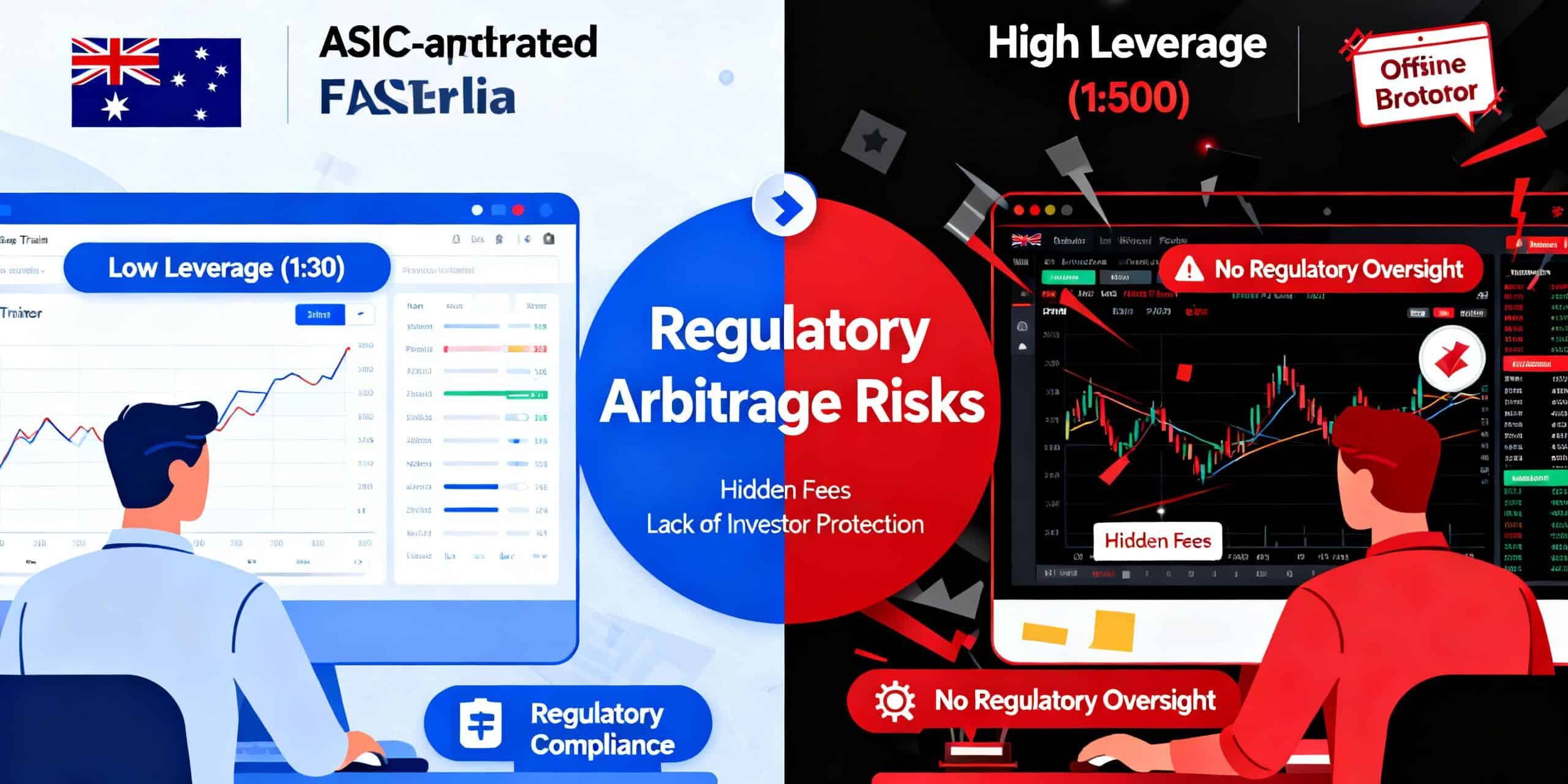
Suppose an aggressive trader wants 200:1 leverage. A regulated Australian broker can no longer offer it. The trader has two choices: accept a smaller position or find a broker outside ASIC’s reach. For a cautious trader, the first option may be perfectly acceptable. For the trader whose strategy depends on high leverage, the second option is the obvious escape route.
That is regulatory arbitrage. The risk does not disappear because one jurisdiction has reduced access to it. It moves to the place where the rules are weaker.
This matters because the protections attached to ASIC-regulated trading were part of the package. A domestic retail client may receive negative balance protection, meaning losses cannot exceed the account balance. They trade with a broker subject to local licensing, supervision and conduct requirements. Complaints have a clearer regulatory pathway. Product intervention rules apply.
An offshore client may receive none of those protections, or only a weaker equivalent. The precise legal position depends on the broker and jurisdiction, but the basic problem is consistent: the trader who leaves to preserve high leverage may surrender safeguards at exactly the moment those safeguards matter most.
That makes the headline conclusion — “retail client losses fell, therefore the caps worked” — dangerously incomplete. Losses may fall among clients who remained with Australian brokers while risk increased for a more aggressive cohort that moved elsewhere. The domestic numbers can look better while the overall risk is simply harder to see.

There is another problem with the cap-first approach: it assumes leverage is the cause of bad trading rather than an amplifier of bad trading. A trader who risks too much can do so with 30:1 leverage. They can also use larger deposits, concentrated positions, exotic CFDs or a string of trades designed to recover an earlier loss. Lowering the maximum available leverage does not teach position sizing, stop-loss discipline or probability management.
It may simply encourage traders to fund accounts with more money to achieve the same exposure. In that case, the nominal leverage ratio falls while the underlying appetite for risk remains.
The opposing view deserves a fair hearing. If caps stop even some inexperienced traders from using absurd leverage, that is a benefit. Regulators are not required to solve every problem perfectly before addressing an obvious source of harm. And a broker cannot protect a client who insists on trading recklessly.
True. But that defence confuses a partial improvement with a successful system. The question is not whether caps can reduce losses for some domestic accounts. They clearly can. The question is whether the policy protected the traders most likely to misuse leverage.
For that group, pushing them toward less regulated venues is not protection. It is displacement.
What I’ve seen instead
The pattern is familiar across financial markets: when a regulated product becomes less competitive, demand does not politely vanish. It migrates.
A trader accustomed to high leverage does not necessarily decide, after encountering a 30:1 limit, that leveraged trading is no longer appropriate. More often, the trader searches for a broker advertising higher leverage. Offshore platforms understand this demand. They market large leverage ratios, fast account opening and fewer restrictions. The features that appear attractive are often the same features that remove friction before a bad decision.
The result is a two-tier market. More conservative traders remain with regulated brokers and benefit from stronger guardrails. More aggressive traders — the cohort regulators most want to influence — have an incentive to leave. Their activity becomes less transparent, their legal recourse less certain and their exposure to counterparty risk greater.
That is why domestic loss data needs to be interpreted carefully. A decline in reported losses at Australian brokers can mean that the caps reduced harmful behaviour. It can also mean that some of the highest-risk behaviour moved beyond the data set. Without accounting for migration, the figures cannot prove the policy delivered broad retail protection.
This is not an argument for unlimited leverage. Unlimited leverage is a terrible product for most retail traders. It is an argument against pretending that a domestic ceiling is a complete safety solution in a global, online market.
A rule that is easy to avoid can change where risk sits without reducing the risk itself. Worse, it can move risk from a supervised environment into one where negative balance protection, dispute resolution and broker oversight are materially weaker.
What this means for you
If you are an Australian retail trader, do not treat an offshore broker as a harmless workaround for ASIC’s leverage limits. The higher leverage is not free. You may be paying for it with weaker protections, more difficult enforcement and greater exposure to the broker itself.
Before opening an account, ask five practical questions:
- Who regulates the broker? Verify the licence with the regulator, rather than trusting a badge on the website.
- Does negative balance protection apply to your account and jurisdiction? Do not assume it does because the broker mentions it somewhere in its global terms.
- Where is the legal entity holding your account? A familiar brand can operate through different entities with different protections.
- What happens if the broker fails or disputes a withdrawal? Understand the complaint and compensation process before depositing money.
- How much are you actually risking per trade? Leverage is only one part of the calculation. Position size and stop distance determine whether one bad move becomes a financial emergency.
The better response to a leverage cap is not to hunt for the biggest number available. It is to decide your maximum acceptable loss first, then use leverage only as a tool for implementing that decision.
Regulators, meanwhile, should measure more than the losses recorded by domestic brokers. They should monitor signs of offshore migration, search behaviour, client complaints, cross-border marketing and the protections surrendered by departing traders. If the riskiest clients are leaving the regulated perimeter, a cleaner local statistic may be evidence of leakage, not success.
The bottom line
ASIC’s leverage caps may have reduced losses inside Australian-regulated accounts, but that does not establish that they protected retail traders overall. By making high leverage unavailable domestically without eliminating the demand for it, the policy helped push some of the most aggressive traders toward offshore brokers where safeguards can be weaker or absent.
The lesson is blunt: risk does not disappear when regulation makes it inconvenient. It moves. Treat leverage limits as one guardrail, not proof that a trading venue is safe — and never exchange regulatory protection for a larger number on a marketing page.