Most beginner traders are told to start with a few hundred dollars, trade tiny positions, and “learn the ropes safely.” It sounds responsible. It sounds patient. It sounds like the opposite of reckless gambling.
I think the advice is fundamentally misleading. A very small live CFD account often does not teach risk management. It teaches you how to behave when risk barely matters. Then, when you increase the size, the habits you built at meaningless stakes stop working.
What everyone believes
The standard argument is easy to understand: beginners should protect their capital while they learn. Small positions limit losses, reduce the cost of mistakes, and give traders a chance to experience the market without blowing up an account.
There is truth in that. Nobody needs to pay a large tuition fee to discover that entering without a stop-loss is a bad idea. If you do not yet understand leverage, margin, spread, or position sizing, keeping exposure low is obviously better than going all in.
But “small” is not automatically the same as “educational.” A trade can be financially safe while being psychologically irrelevant. That distinction is where the conventional advice falls apart.
Why that’s wrong
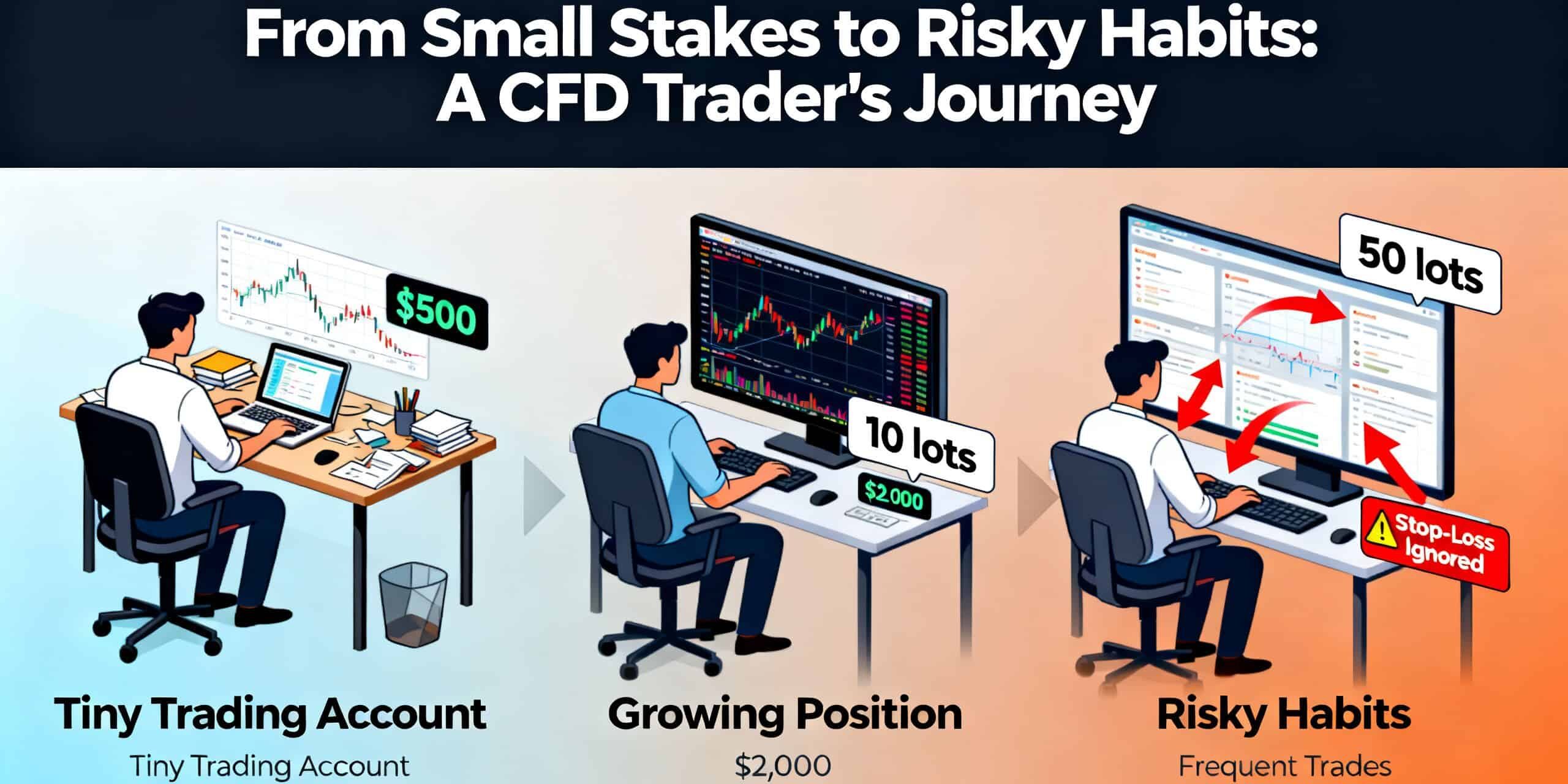
Suppose a beginner opens a live CFD account with $500. They risk $8 on a trade. The position moves against them, and they close it at a loss.
Was that uncomfortable? Perhaps. Was it useful? Only if the loss created enough pressure to expose a flaw in the trader’s decision-making.
For many people, $8 is not consequential. They may dislike seeing red on the screen, but the loss does not alter their week, their plans, or their sense of financial security. They can shrug, open another position, and tell themselves they are collecting experience.
That is not the same emotional environment as risking $80, $150, or $300. At meaningful size, traders routinely move stops, cut winners too early, widen losses, revenge trade, or abandon a valid strategy after a normal losing streak. Those behaviors are not theoretical. They emerge when the nervous system decides the money is important.
A tiny account can hide all of them.
The beginner may follow the plan perfectly because the plan is easy to follow when nothing meaningful is at stake. They may hold a losing trade calmly because the loss is trivial. They may take the next setup with confidence because the previous mistake cost less than dinner. Then they increase their position size and discover that their “discipline” was partly a product of having no real emotional conflict to manage.
This is the central mistake in the start-small argument: it treats trading as if the only variable being trained is technical knowledge. It is not. Trading is also the management of uncertainty, discomfort, temptation, and loss. If the money involved is functionally meaningless, you are not fully training those skills.

There is another problem. Small accounts can encourage distorted expectations. A trader sees a 20% return over a short period and feels validated, even though the dollar gain is insignificant and the result may depend on taking oversized percentage risk. They learn to evaluate success by account percentage rather than by the quality and repeatability of the process.
Later, they try to preserve that percentage return with more capital. The mathematics may look identical, but the psychology is not. A 5% drawdown on $500 feels very different from a 5% drawdown on $50,000. The trader assumes they are scaling a proven process. In reality, they may be scaling behavior that was never tested under meaningful pressure.
What I’ve seen instead
The pattern is familiar: a trader starts cautiously, records a string of manageable losses, and concludes that they are becoming disciplined. Their entries are planned. Their stops are placed. Their journal looks respectable.
Then the account grows, or they deposit more money, and the rules begin to bend.
A stop that was automatic at a tiny size becomes negotiable. A planned loss becomes “room for the trade to recover.” A winning position gets closed early because the unrealized profit suddenly feels too valuable to lose. After two or three mistakes, the trader tries to make the money back quickly and abandons the process altogether.
The trader usually describes this as a problem that appeared when the account got larger. More accurately, the larger account revealed a problem that the tiny account concealed.
I have also seen traders mistake activity for learning. They place dozens of low-stakes trades, review them, and accumulate a record of outcomes. But if every loss is painless, the review misses the most important information: what happens when the correct action feels personally expensive?
A trading journal can tell you that you moved a stop. It cannot, by itself, teach you why you moved it when the position size made the loss emotionally real. That lesson requires a level of exposure that is still survivable but no longer imaginary.
This does not mean beginners should deliberately risk money they cannot afford to lose. It means the goal should not be to create the smallest possible emotional reaction. The goal should be to find a controlled level of risk that makes discipline necessary without making failure financially destructive.
That is a very different standard from “start with a few hundred dollars and see what happens.”
What this means for you
First, separate technical practice from psychological practice.
Use a demo account, replay tool, or very small position to learn the mechanics: how orders work, how spreads affect entries, how margin behaves, and how to calculate position size. These are excellent reasons to start small. They do not require meaningful financial pressure.
But when you move to live trading, define risk in terms of your actual finances and your ability to follow rules under stress—not in terms of an arbitrary account balance.
Before increasing size, ask yourself:
- Have I followed my entry and exit rules across a meaningful sample of trades?
- Have I experienced a normal losing streak without changing the system?
- What do I do when a profitable trade begins to reverse?
- Have I ever moved a stop, doubled down, or revenge traded—and what triggered it?
- Is the amount at risk small enough to survive, but large enough that breaking my rules has a consequence?
The last question matters most. “Small” should mean survivable, not irrelevant.
Increase exposure gradually, and do it one variable at a time. If your position size doubles, do not simultaneously add new markets, change strategies, and trade more frequently. Watch for behavioral changes, not just account performance. The first warning sign is often not a larger loss. It is a subtle change in execution: hesitation, premature exits, skipped setups, or rules rewritten in the middle of a trade.
And be honest about what your results prove. A profitable record at tiny stakes proves that you can execute under tiny-stakes conditions. It does not prove that you can manage risk when the outcome matters.
The bottom line
Starting with a very small live CFD account is not automatically safe education. If the losses are too small to matter, the account can train confidence without training composure—and that is exactly when bad habits become expensive.
Start small enough to survive, but not so small that every decision is emotionally consequence-free. The point is not to feel fearless. The point is to build a process that still works when the money finally matters.