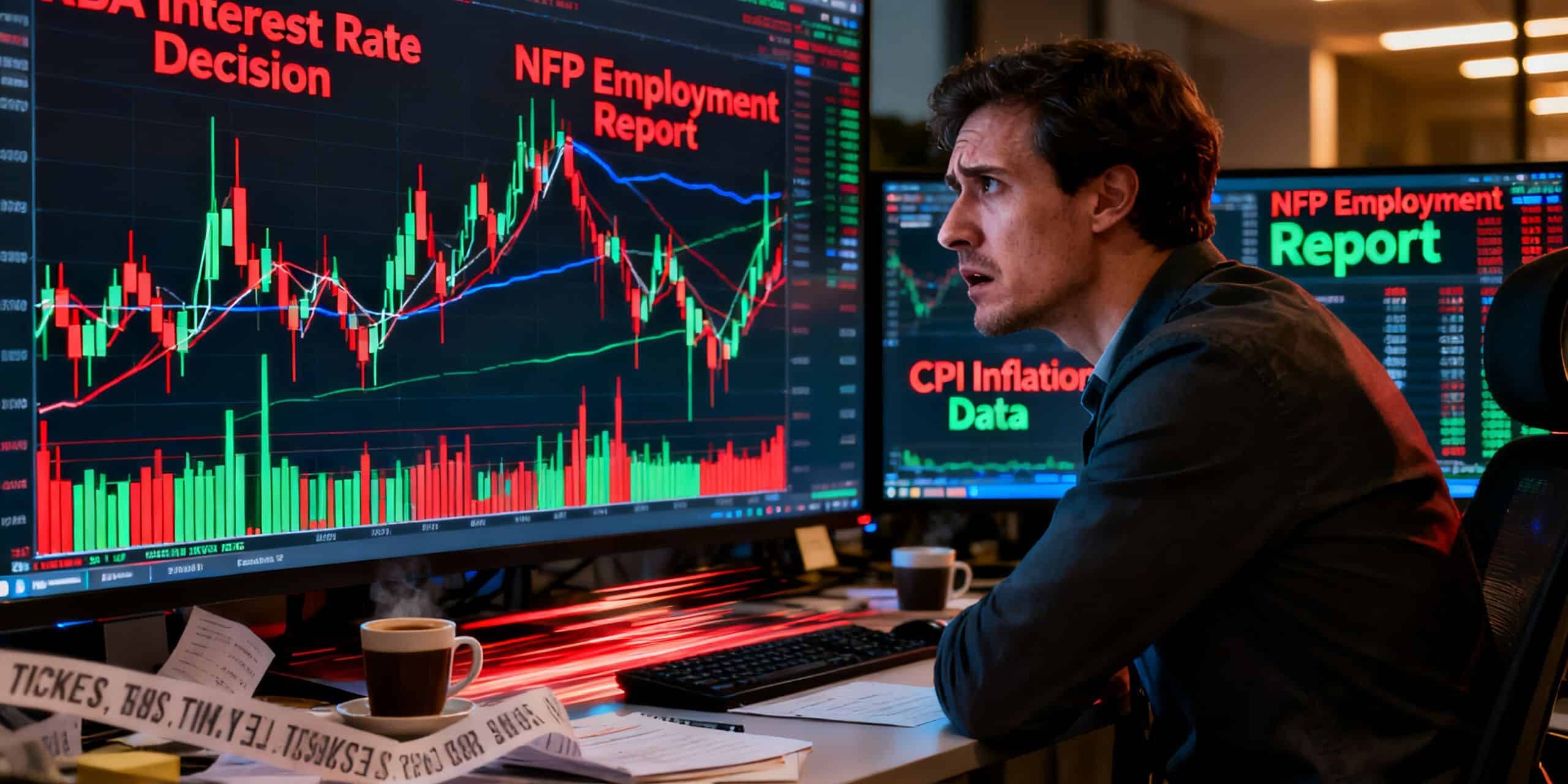
The economic calendar is not a trading edge. In the seconds around an RBA rate decision, US nonfarm payrolls report, or CPI print, a retail CFD trader is usually stepping into the market at its most expensive, least predictable, and least forgiving point.
That is not because news does not move markets. It does. The problem is that the move is packaged as an opportunity when, for most retail traders, it is closer to a high-speed auction where the fastest participants get the best prices and everyone else pays for access.
What everyone believes
The conventional playbook sounds reasonable. Mark the major events on your calendar. Decide what the market expects. Prepare a bullish and bearish scenario. Set a stop-loss. When the number lands, trade the reaction.
There is some sensible advice buried in that framework. Traders should know when high-impact data is due. They should understand the difference between an expected result and a surprise. They should have a defined risk limit.
But the conclusion most platforms draw is wrong: that preparation makes the release itself a high-quality trading opportunity for retail clients.
A calendar tells you when uncertainty arrives. It does not give you an execution advantage when the uncertainty is being repriced in milliseconds.
Why that’s wrong
The central issue is not whether you can guess the direction. It is whether you can get paid for being right after accounting for the conditions in which you have to enter and exit.
Around a major release, spreads commonly widen because liquidity providers do not want to quote tightly while the value of a currency, index, or bond-sensitive asset may change abruptly. The price you see before the release may have little relationship to the price available when you try to trade it. Slippage can turn a planned entry into a materially worse one. Stops can be filled away from their trigger level. A position that looked correctly sized on paper can become much larger in practical risk.
That destroys the neatness of the usual plan.
Suppose the market expects the RBA to hold rates but is focused on the statement’s language. The decision lands. AUD/USD jumps, reverses, then jumps again as algorithms parse the headline, the wording, and the implications for future policy. A retail trader who buys the first move is not simply expressing a view on Australian rates. They are competing for execution with firms that receive and process the information faster, have deeper infrastructure, and can provide or withdraw liquidity before a manual order is confirmed.
The same applies to US CPI and NFP. The headline number is only the first layer. The market also cares about revisions, subcomponents, the unemployment rate, average hourly earnings, participation, and how the result changes the expected path of central-bank policy. A strong headline can produce a weak market reaction if the details point the other way. By the time a retail trader has interpreted the release and clicked buy or sell, the cleanest part of the move may already be gone.
This is the part that “opportunity spike” marketing leaves out: volatility is not the same thing as opportunity. Volatility increases both the possible reward and the cost of being late, mis-sized, or stopped out in noise. When spreads widen and slippage explodes, the breakeven point moves against you before your analysis has had a chance to matter.

The opposing view deserves a fair hearing. Experienced discretionary traders can sometimes trade news profitably. A trader with a tested process, reliable execution, strict limits, and a genuine understanding of the data may find specific event structures that suit them. Avoiding every release is not a law of finance.
But that exception does not rescue the retail-news-trading pitch. The question is not whether anyone can profit from a news release. The question is whether trading the release itself is a sensible default for retail CFD traders. It is not. A handful of successful examples proves possibility, not positive expected value for the average participant.
What I’ve seen instead
What I see repeatedly is a mismatch between the trader’s preparation and the market’s actual difficulty.
A trader spends an hour building a scenario tree for NFP. Payrolls beat expectations, so they buy the dollar. The first candle surges, their order fills late, and the price reverses. The trader calls it a false breakout. Sometimes it is. But often the more useful diagnosis is simpler: the setup was never designed to survive the execution environment.
Another trader places a stop just beyond the pre-release range, believing the distance reflects their risk. The number triggers a violent wick, the stop is filled at a worse price, and the market then travels in the original direction. They conclude that the broker hunted their stop or that the market is irrational. Those things may be debated, but neither changes the basic fact: trading during a liquidity vacuum makes ordinary stop placement unreliable.
There is also a selection problem. Screenshots circulate when a trader catches the first move after CPI. Nobody posts the trades that were skipped because the spread widened, the order slipped, or the initial move reversed before execution. The visible winners create a distorted impression of repeatability.
The market’s reaction to news is not a clean scoreboard of who predicted the number. It is an auction involving expectations, positioning, hedging, liquidity, and rapid repricing. Being directionally correct is necessary in some cases, but it is not sufficient. Entry price, fill quality, spread, timing, and exit conditions can decide the result before the thesis is fully expressed.
That is why a trader can be “right about NFP” and still lose money. The forecast and the trade are different things.
What this means for you
First, stop treating the calendar as a list of invitations. Treat it as a list of conditions that may make trading more expensive and less reliable.
If your strategy has not been specifically tested on release-time spreads, slippage, gap risk, and stop execution, do not assume it works because it performs during normal sessions. Remove the word “surprise” from your risk model unless you have measured what a surprise does to your actual fills.
Second, consider trading the aftermath rather than the instant of release. Let the first reaction occur. Wait for spreads to normalize and for the market to reveal whether it is accepting or rejecting the new information. You will miss some moves. That is a feature, not a defect. A missed trade costs nothing; a low-quality fill can damage both your account and your decision-making.
Third, use the event to improve your context, not manufacture urgency. An RBA decision can change the medium-term environment for AUD pairs. CPI can reshape rate expectations. NFP can alter the dollar’s broader trend. You can incorporate that information into a setup that forms later, when liquidity is deeper and execution is less chaotic.
Finally, measure your results honestly. Separate trades entered before, during, and after the release. Track quoted spread, actual fill, slippage, stop distance, and time to exit. If the release trades are profitable only before realistic costs—or only because one lucky winner offsets several difficult losses—you do not have an edge. You have an appealing story.
The bottom line
Trading the news release itself is one of the worst-EV default setups for retail CFD traders. The event may be important, and the movement may be dramatic, but dramatic movement is not a substitute for favorable execution or positive expectancy.
Use RBA decisions, NFP, and CPI to understand the market—not to volunteer for the most expensive seconds of the session. Let the fastest participants fight over the first reaction, then act only when the price, liquidity, and risk make the trade worth taking.